LEADERS

TOP International LEADERS Calling Market Crashes Years Ahead
Second to None, Anywhere...

'Warned 2000 tech slide; predicted 2008 meltdown in 2007. Forecasted 2020 global economic collapse in 2011, AND NOW- BY 2050 - THE MOTHER OF ALL CRASHES"

Funtastic Deal - Free Kindle

TOP POST - WHAT ARE COMMUNITY IS READING

A #TALE OF TWO CITIES - #ECONOMICS AND #SCIENCE COLLIDE

  SURREAL ECONOMICS OR CONCRETE SCIENCE? Original Post It  was the best of times, it was the worst of times, it was the age of wisdom, it wa...

Lead, Follow or Dream

Search This Blog

BIG SAVINGS ON HOT STUFF

Thursday, April 7, 2016

Panama Papers: Window to Wealth, Power and Corruption

 OR WHO REALLY CARES ? 

 The Panama Papers, a leak of over 11 million documents from the Panamanian law firm Mossack Fonseca.
For decades, the firm has helped individuals and institutions incorporate their financial assets. On Sunday the International Consortium of Investigative Journalists published its findings from the data dump, including assets incorporated by people close to world leaders like Russian President Vladimir Putin and Chinese President Xi Jinping.


The Panama Papers: This Is the Consequence 

of Centralized Money and Power

By Charles Hugh Smith

Technologies such as the blockchain are enabling alternative ways of creating and distributing money outside central banks and states.
If we don't change the way money is created and distributed, we will never change anything. This is the core message of my book A Radically Beneficial World: Automation, Technology and Creating Jobs for All.
The Panama Papers offer damning proof of this: increasing concentrations of wealth and power that are free of any constraint (such as taxes) is not just the consequence of centralized money and state power--this inequality is the only possible output of centralized money and state power.
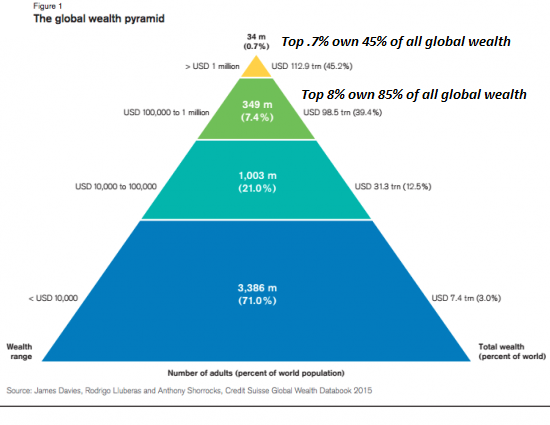
Here is a graphic portrayal of just how concentrated global wealth really is: the top .7% (less than 1%) own 45% of all global wealth, and the top 8% own 85%.
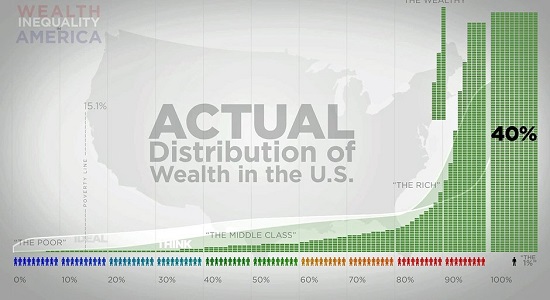
Here is a depiction of wealth in the U.S.:
Here is my description of how centralized money and finance inevitably creates debt-serfdom as its only possible output:
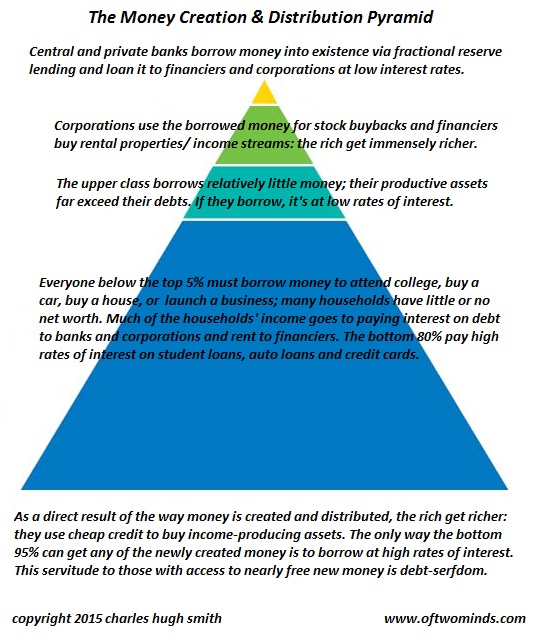
Once the creation and distribution of money is centralized, the corruption of political power is inevitable, as wealth can always buy political favors, such as tax evasion schemes.
Concentrations of private wealth and the central state are simply two sides of the same coin. Private wealth, monopolies and cartels are all protected and enforced by the state/central bank: the status quo exists to protect the privileges of the few at the expense of the many. Well-meaning but hopelessly naive people are constantly proposing "reforms" of the status quo--reforms that are doomed from the start because they fail to change the way money is created and distributed.
As long as central banks create and distribute money to banks, which are free to use the money for speculation and lend vast sums at near-zero rates of interest to corporations and financiers, nothing can possibly change.
Recall that the central state enforces moral hazard: if banks reap vast profits on their gambles, they keep the winnings and can use a sliver of this wealth to buy political favors from politicos like Hillary Clinton.
If they lose the bets and are insolvent, the federal government and the central bank (Federal Reserve) bail them out by transferring the losses to the public or by rigging the system to funnel cash to the banks via paying interest on deposits held at the Fed (while slashing interest income to the serfs to near-zero).
There is another way to run the world: if money is decentralized, i.e. created by a distributed, decentralized system that pays people directly for their labor, rather than being distributed to banks to lend at interest, the sort of concentrations of wealth, power and exploitation enabled by central banking would no longer be possible.
Technologies such as the blockchain are enabling alternative ways of creating and distributing money outside central banks and states. I describe a labor-backed crypto-currency in my book A Radically Beneficial World. The potential of the blockchain to disrupt and bypass central banks' monopoly of money creation is revolutionary, which explains why Goldman Sachs and their cronies are desperate to own their own versions of blockchain technologies.
But the cats are out of the bag, and central bankers and their cronies will have a difficult time herding these new technologies back into the enforced serfdom of central banking. The only way to bring down the corruption created by the concentration of wealth and power is to dismantle the monopoly of money creation held by central banks and their private-bank cronies.


Monday, March 28, 2016

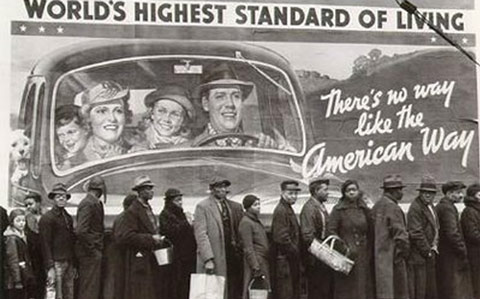
America Today: The Death of a Middle Class

SPECIAL REPORT
 Your Hometown, My Hometown  

Even the most liberal economists acknowledge that under  globalization and free trade agreements there will be winners and losers. That's the reality of the "invisible hand" and it makes abundant sense. 

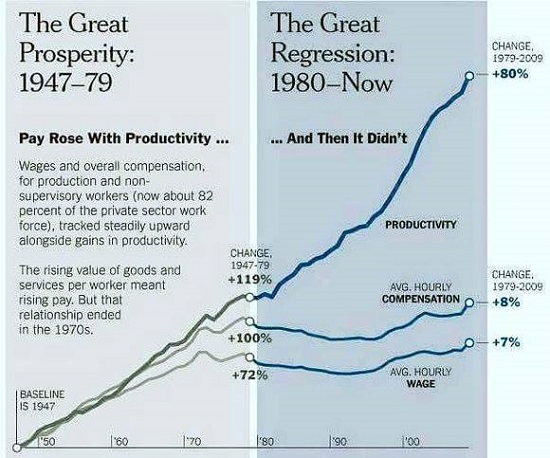
Now guess who has not been a big winner over the past 35 years under this global economic policy initiative? And here are a few articles that support what is readily a self-evident truth to most,  and particularly for the 99% who are  suffering under its consequences. 

Our Hometown...

" they say these jobs are going boys, and they aint coming back"


My Hometown
May, 1983
B. Springsteen 


  The Death of a Middle Class 


Blockbuster Job Growth Still Isn’t Turning Into Big Raises For American Workers


The economy added 242,000 jobs in January while the unemployment rate stayed unchanged at 4.9 percent, according to the latest data from the Bureau of Labor Statistics. Analysts had expected 190,000 jobs to be added.
That maintains the lowest unemployment rate in 2008. The number of jobs added in December of last year was revised up by 9,000, while January was revised up by 21,000. With revisions included, the economy has been adding jobs at a 228,000 average monthly pace, matching the pace of growth in 2015. The labor force participation rate and employment-population ratio both edged up in February, signs that more people are joining the labor force and seeking jobs.
READ MORE


Globalization Destroys American Middle Class

Storm the Bastille


In the last analysis, globalization has only benefitted the rich and led to the quiet destruction of society and the middle class. We need to become more self-reliant. more centred in our culture and effect policies that bring middle class jobs back to North American shores.


If we fail and continue on globalization's  clear path to self destruction, then the possibility of a quiet revolution becomes a greater risk t caused by the freshly minted legions of poor middle-class folks. 

History has an odd habit of repeating itself.

"Let them eat cake' 


Why Globalization Reaches Limits

We have been living in a world of rapid globalization, but this is not a condition that we can expect to continue indefinitely.

Each time imported goods and services start to surge as a percentage of GDP, these imports seem to be cut back, generally in a recession. The rising cost of the imports seems to have an adverse impact on the economy. (The imports I am showing are gross imports, rather than imports net of exports. I am using gross imports, because US exports tend to be of a different nature than US imports. US imports include many labor-intensive products, while exports tend to be goods such as agricultural goods and movie films that do not require much US labor.)

READ MORE


Visualizing Why Manufacturing Jobs Aren't Coming Back


 The market for industrial robot installations has been on a skyward trend since 2009, and it is not expected to slow down any time soon. According to the World Robotics 2015 report, the market for industrial robots was approximated at $32 billion in 2014, and in the coming years it is expected to continue to grow at a compound annual growth rate (CAGR) of at least 15%.

As VisualCapitalist's Jeff Desjardin notes, that means between 2015 and 2018, it’s anticipated that 1.3 million industrial robots will be installed worldwide. This will bring the stock of operational robots up to just over 2.3 million, mostly working in the automotive and electronics sectors.
For how long can the global robot population continue to grow?
READ MORE


What Killed the Middle Class  


Everyone knows the middle class is fading fast. I've covered this issue in depth for years, for example: Honey, I Shrunk the Middle Class: Perhaps 1/3 of Households Qualify (December 28, 2015) and What Does It Take To Be Middle Class? (December 5, 2013)
This raises an obvious question: what killed the middle class? While many commentators try to identify one killer cause (for example, the U.S. going off the gold standard in 1971), the die-off of the middle class is more akin to the die-off in honey bees, which is the result of the interaction of multiple causes (factors that increase the toxic load dumped on bees and other pollinators by modern agriculture).

Longtime collaborator Gordon T. Long and I discuss the decline of the middle class and other key topics in a new 29-minute video How did that work out for you? 

READ MORE


This Theory Explains Why the U.S. Economy Might Never Get Better

Why hasn't America's economy recovered more robustly? Economists have an unsettling answer

In the wake of the 2008 financial crisis, conventional wisdom among economists, business leaders, and policy makers was fairly straightforward: Once the banks were bailed out, the stimulus spent, and businesses had a few years to recover, the U.S. economy would return to its usual healthy growth. Time, in other words, would heal the wounds of the subprime collapse and subsequent turbulence. But if any recovery has turned conventional wisdom on its head, it’s this one.
Inline images 1Over the last eight years, America’s economic prospects have lagged even the most pessimistic early predictions. In 2011, the Federal Reserve predicted that U.S. real GDP would, at worst, grow by 3.5% in 2013 and that the economy would expand between 2.5% and 2.8% annually in the long run. In every year since, the Fed has revised its predictions downward. (The most recent estimate predicts 2.2% annual growth in 2016, and 2% growth in the long run—a rate more than one-third lower than the post-war average.) Even employment, a source of uplifting headlines in recent weeks, is deceptively weak. The unemployment rate—which ignores those who gave up looking for a job—has hit new lows, but the percentage of Americans (between ages 25 and 54) who are actually working is over three points lower than its pre-crisis peak.
READ MORE

 Our  Hometown..
"Now Main Street's whitewashed windows and vacant stores
Seems like there ain't nobody wants to come down here no more

They're closing down the textile mill across the railroad tracks
Foreman says these jobs are going boys and they ain't coming back to your hometown
Your hometown
Your hometown
Your hometown


Last night me and Kate we laid in bed
Talking about getting out
Packing up our bags maybe heading south
I'm thirty-five we got a boy of our own now
Last night I sat him up behind the wheel and said son take a good look around


This is your hometown" 


Believe, Act, Learn

https://www.addtoany.com/

LEARNING LIBRARY